This is a slightly tongue-in-cheek report on the LILAC 2024 conference, held in Leeds Becket University from Monday 25th to Wednesday 27th March 2024.
The seven rules of LILAC
With apologies to Chuck Palahniuk, and thanks to two anonymous posters
 You do talk about LILAC.
- You do talk about LILAC!
- But when the session-chair says stop, you stop.
- As many presenters as you want. And any colour you like, so long as it’s LILAC.
- At least two parallel sessions at a time – and you’ll want to go to all of them. Put thyself through a 3-D photocopier.
- Present with activities (Padlets, Menti, Slido, post-its, sharpies: all that good stuff)
- Revere Queen Jane and her court.
- If this is your first time at LILAC (even if it’s not), party until it’s pumpkin-time. LILACers don’t get hangovers.

OK, so what happened at LILAC 24 really? (AKA This is my truth, tell me yours.[1])
Sunday evening
- Arrive in Leeds at late o’clock, then walk to hotel. Realise I’ve forgotten my toothbrush, so try to buy one at the hotel. Receptionist tells me to go to a nearby Co-op because it’ll be cheaper.
Monday morning
- Have breakfast for the first time in years. Walk to the conference venue.
- First session[2] gets me buzzing! Am I a hypocrite in the way I treat students? My answer is ‘no’ only because I don’t currently teach, but in the not-too-distant future I may have two PhD students.
- Keynote on AI and IL gets me thinking. I’ve never deliberately used AI, apart from (maybe) online searches. (Powerpoint had suggested some alt-texts for images in my LILAC presentation, but they were inappropriate and so were terminated with extreme prejudice.) In brief, people will have used AI before they get to HE/FE, and will use it afterwards. So part of HE/FE’s role is to prepare them to use it well. Hence I have much learning to do!
Monday afternoon and evening
- Miss the first session after lunch because embroiled in conversation with other LILACers. Second session[3] makes me think again, this time about ‘informed learning design’ – basically starting from what you want learners to learn, then deciding how to facilitate this, then deciding how to assess learners’ learning. Am very strongly reminded of collaboration between teachers and librarians, a key point of my recent research.
- Final session of the day[4] is activity-filled, so I don’t tweet. One activity is debating ‘The use of information literacy language alienates students and is a barrier to engagement.’ I debate against – while academic language clear can be something of a barrier, I think it’s important to have and use precise terms to clearly communicate, but this presupposes others agreeing on terms’ definitions.
- Attend the evening networking and awards session. I’m sure others will have described it better online. Have a fab south Indian meal at Indian Tiffin Room: idli and a Mysore masala dosa. South Indian is the best type of food in the world, I think, and is so often vegan. (Some recipes call for butter.) Yeehah!
Tuesday morning
- Back at my hotel, toss and turn for ages. Get charged £4 by my hotel for a bottle of water. Eventually get to sleep well after 5am. Sleep through my alarm and so miss the morning’s presentations and keynotes. Load up my rucksack with giveaways and take a taxi to the conference venue. Find that Leeds taxis only take cash payments, so fare goes up by about £3 during search for a cash-point.
Tuesday afternoon/evening
- At lunch, encounter a couple of Danish attendees who are looking forward to my presentation. Chat about Nordic history (which countries held power when, the various unions[5]), linguistic variations stemming from history, and rural/urban and mainland/island differences, other travel, the attraction of Edinburgh. First session of the afternoon[6] is attractive mostly because of both the subject matter and but partly because it’s in the same room as my presentation immediately afterwards. A lot of learning about the effects of COVID on students, which takes me back to when we were all frantically adapting to online teaching. I recall giving group sessions to students preparing for their MSc projects in 2020, when I couldn’t get any interaction to see if I was doing right by them. Big thanks to presenters Katie and Hannah for also using padlets, and so convincing me mine would work.
- 63 people have booked for my session, and it looks like most come! I don’t make a mess of it. People make lots of comments on my padlets, some making me guffaw in public, but most making very valid points. Padlets are now on my own research blog, and I have much thinking to do. Am also delighted to share the fantastic news that my colleague Marina Milosheva passed her PhD viva yesterday, with no corrections to her thesis being needed. Later in the conference, an attendee tells me my presentation has crystallised things for him as a relatively new librarian. And yet I was in awe of some of his contributions to debates and conversations.
- Final session of the day[7] very sparsely attended, perhaps because it’s about primary education and IL. This is disappointing – I think primary age IL and digital literacy learning are important foundations for later learning. hope the project is funded for further iterations, as relevant material is published. Meanwhile, here’s my thoughts on the Scottish presentation of the BRIDGE project: https://blogs.napier.ac.uk/social-informatics/2024/02/view-from-the-bridge.
- A wee pause back at my hotel, then walk back into town for the conference party. Good chat, good food, excellent bouncing to 80s synth-pop. But then the music goes back to the 70s and I turn into a pumpkin.
Wednesday morning
- No hangover! First session[8] challenges my class consciousness. Can’t help that I’m middle-class (mother was primary school teacher, originally from a higher-class Viennese family (they had maids!) but then came Adolf; my father was a production engineer, originally from Sydney). So what are my obligations here? Again, much thought needed!
- Keynote on Playful and compassionate approaches for inclusive Information Literacy instruction is very enlightening. Playfulness seems to be a way of getting folk ‘on-side’ and enabling them to explore. Dunno how to do this yet, but I know that unless we enjoy our work, life is crap. (Been there, done that, designed and printed the t-shirt: this is why I’m in academia and no longer a publisher’s minion.) How can I make any future teaching or presenting fun, so it’s memorable for the right reasons? Watch this space.
Wednesday afternoon and evening
- First session[9] digs into the trials and tribulations of librarians needing to help law lecturers be ready to publish everything open access, a new requirement in Canada. They’re lawyers, yet don’t know contractual details such as whether they or journals retain copyright on their papers – and the journals themselves may not publish this. The lecturers don’t know how to do research data management. The library is understaffed. The session shows what these librarians do in the face of such challenges.
- Second session[10] goes into research information landscapes, context-specific research plans, critical librarianship, the dominance of academia and mainstream institutions within such landscapes and the exaltation of peer review. Personal thought is that the latter is a minefield of unpaid labour, but I relate to speaker’s concerns from my community-led participatory budgeting work. Speaker notes the importance of reciprocity between researchers and the communities they research.
- Final session ponders an anniversary: where will we be after another 50 years of information literacy? One of the provocations is an implication that IL is (only) Boolean search-operators. Stéphane and I go politely radge[11]. Booleans are important tools for library searching, but IL is so much more – it’s about what you do before and after searching, why you do these, and the contexts of it all. Hey, I guess that provocation worked!
- And there’s two more important questions: what will the next anniversary t-shirt design be? And who will model it? I vote for Jane Secker still – she was the originator of LILAC.
- And that’s it. Daunder back to Leeds station. Inhale a vegan McDonalds (dirty sell-out that I am). Bother ticket-info-people about strikes affecting my travel next weekend. On the train, don leggings under my kilt because I’m heading to the frozen north. Arrive late at York because that train is a clapped-out chugaboom. Friendly ticket-office person books me a seat on the next train to Edinburgh for free despite my ticket being Advance Single (‘travel on this specific train or die’). Succumb to Pret a Manger soup. Arrive in Edinburgh about 10pm. My ever-wonderful wife is waiting for me, and all is well with my world.
All through the conference
This was my first time at LILAC. It was far more engaging and activity-filled than most academic conferences I’ve been to. Great conversations with Stéphane, Sarah, Jane, Drew, Maria, Stacey, Liesl, many others (names forgotten, sorry!). LILAC folk are so helpful and welcoming. I learn so much more about librarians and librarianship. Now it’s time to ponder my padlets, and find directions (and funding!) for more IL research. Where can I best contribute? Answers on a postcard to b.ryan@napier.ac.uk, please!
And finally
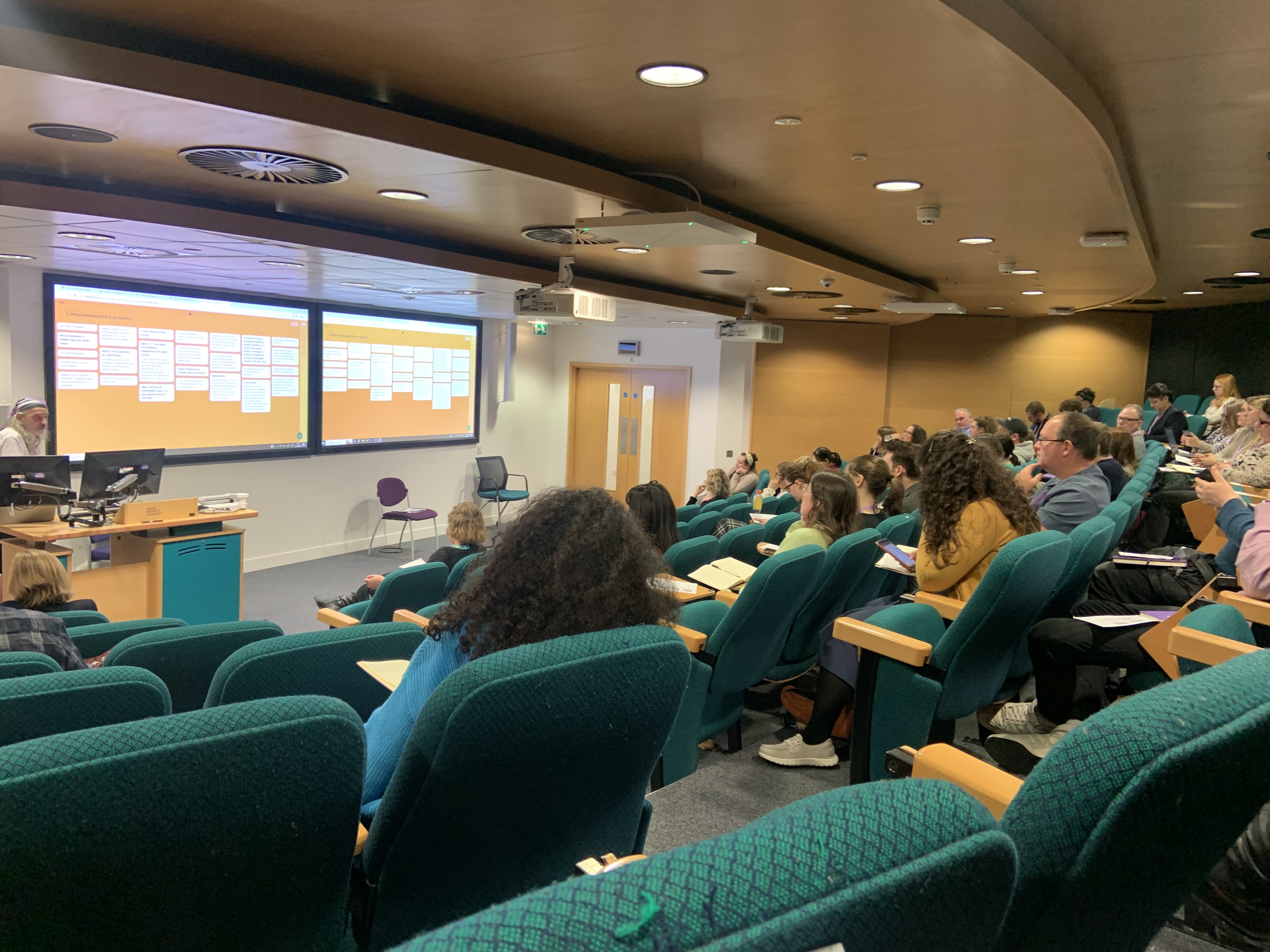
Just to attack your eyes, some photos of me presenting (photo-credit Drew Feeney) and partying (photo-credit Amber Edwards)



[1] Inevitable Manics reference!
[2] “Never have I ever used Google Scholar”: hypocrisy and authenticity in library and academic skills teaching, presenters Rachel Davies and Joe Larkin (slides on Slideshare)
[3] Librarians and teachers co-designing for information literacy: creating informed learners in the classroom, presenters Clarence Maybee and Michael Flierl (slides on Slideshare)
[4] The information literacy behind information literacy: a (wild!) discussion. How do we communicate for maximum impact?, presenters Amy Haworth, Georgie Broad and Helen McNaughton (slides on Slideshare)
[5] I stopped formal study of history as soon as I could – 2nd year of secondary education – because it was all about monarchy and wars, both abhorrent. I received almost no teaching about Nordic history apart from ‘there were these huge hairy Vikings – they raped and pillaged, and then some settled down in England and became decent chaps, what’. I enjoy learning about how history has affected language. I speak no Nordic languages.
[6] “Typically, I keep looking for a little bit longer”: examining changes in students information behavior and emotional responses to research, pre- and post-COVID-19 shutdowns, presenters Katie Blocksidge and Hanna Primeau (slides on Slideshare)
[7] View from the BRIDGE: information and digital literacy for primary schools, presenters Stéphane Goldstein, Sarah Pavey and Konstantina Martzoukou (slides on Slideshare, project website)
[8] Information literacy: social class perspectives, presenters Darren Flynn, Rosie Hare. Jennie-Claire Crate, Ramona Naicker and Andrew Preater
[9] Talk that talk: creating a research support program for faculty members, presenters Sandy Hervieux, Ana Rogers-Butterworth (slides on Slideshare)
[10] ‘What does research mean to you?’: unpacking information hierarchies and creating context-specific research plans, presenter Salma Abumeeiz (slides on Slideshare)
[11] NSFW definition here: https://www.urbandictionary.com/define.php?term=radge
 Bruce's IT-ish world
Pingback: LILAC conference, 25 to 27 March 2024 - Social Informatics research