
On Thursday 9 October, I attended this panel event at the Scottish Parliament. It took place in banned books week. This post is based on my brief notes of what was said. I apologise if I have misrepresented anyone.
The event was hosted by Michelle Thomson MSP, introduced by Sean McNamara (CILIPS director) and chaired by David McMenemy (CILIPS President). The panellists were Cleo Jones (former CILIPS president and former Edinburgh libraries development manager), Shelagh Toonen (CILIPS vice-president), Alastair Brian (The Ferret) and Professor Steven Buchanan.
Panel session
1. What are the panellists’ positions on intellectual freedom?
CJ Intellectual freedom is foundational to democracy but we need education to take advantage of it This is part of what libraries are and do.
SB Times are very challenging just now. New aspects of technology, e.g. social media, need bravery.
ST Intellectual freedom supports education, learning and questioning. These shape our lives, so it’s vital to protect intellectual freedom.
AF The Ferret tries to provide information, even if those in power don’t want this. For example, there are SLAPPS etc. We need access to public information, including information about money. Online abuse stifles people.
DM SB and I are currently researching self-censorship.
2. Should there be more censorship in/by libraries?
ST Librarians should be free to develop their own collections but need to bear in mind young people’s development needs. School librarians need to be transparent with their teacher-colleagues.
CJ There shouldn’t be further limits: see article 19[1] of the Universal Declaration of Human RIghts. We need to ensure people understand why this is important, so we need to look at education. It should cross-cut, not just be one small part of education. We need to be aware that there are filter bubbles, in which people see things with more likes as being more important.
AB From an outside perspective, it’s important to understand why these things are happening
SB In principle there should be no limits, but there are qualifications: is a thing or action legitimate and proportional.
3. How can libraries/librarians balance intellectual freedom with community standards?
AF The constant shifts [in opinion/community standards] are a problem.
CJ I founded Edinburgh Council’s equalities development. Many staff wanted to be in this. With hindsight, maybe we should have put in intellect freedom and making sure libraries are for everyone. Both are important
SB The key word is ‘neutrality’, providing equal access to information.
ST it is right that all can access information and ideas, so the right approach is dialogue and transparency. Make sure parents know why this is so, why certain actions are being taken. If a book is banned by a school, this needs dialogue. We must remember that young people have their own rights from age 13.
4. How have culture wars affected libraries?
SB There is not yet enough research, but libraries seem to be in difficult positions according to research so far. Librarians are in fear. Self censorship (it’s difficult to research this) has been demonstrated by a couple of studies.
ST I’m thinking of The librarians documentary film, and of Moms for liberty. Most freedom of information (FOI) requests I receive ae about LGBTI+ matters.
AB The Ferret is researching how culture wars are being imported from the USA to the UK. At the moment culture warriors are less organised in the UK, but the wars are going to grow. They are singling out librarians and other professionals – this is definitely having a chilling effect on their work. For example, Turning Point USA is coming to the UK.
DM These clashes aren’t new, but social media and the ability to instantly attack people across the world add a new dimension.
CJ I dealt with all FOIs about Edinburgh Council and children. The foundation for handling them is a robust collections policy. We have only moved one (explicit) book to a section for older children but have not actually removed any books. It’s harder to handle events and spaces. For example, ‘drag queen story hour’ received a lot of abuse, most from the USA. However, the positive comments outweighed the negative comments. Despite this, we are still dealing with the fallout of a legal challenge, so a huge amount of management time is being spent on this. There have been major threats to individuals. The lessons are to be transparent, and do due diligence first.
5. How can politicians/elected officials support intellectual freedom?
SB By providing clear support! There is a question over who should set standards about what should be in libraries. Maybe this should be done by an independent body but it’s very complex. Governments shy away from this issue too.
CJ Librarians need to talk with our representatives. People trust libraries: they are strong. They work with communities. We need to tell our users what we do!
ST Advocacy, funding, promotion, opposing censorship
AB Public officials set standards. School libraries and their stock are very poorly funded[2]. Tackling mis- and disinformation is part of librarians’ roles. We need to fix postcode lotteries.
SB Intellectual freedom and books: we need counter-arguments, tolerance and respect. We need to argue properly![3] The current situation may be impacting schools, affecting our ability to see arguments, and moving us to short-termism.
Audience questions and comments
Bill Johnson: Thank you to all the panellists. Information dystopia is here already. I would like citizens assemblies, as a bulwark against Trumpism.
MT Absolutely. It’s not just about mechanisms. We as Scotland’s parliament need to hear from everyone. It’s been eye-opening to see how decisions are made here. Whipping can be counterproductive. The Scottish parliament must be part of the modern enlightenment.
An audience member: A cross-party group for the libraries and information sector would highlight the role of libraries.
Bruce Ryan: Given Rachel Reeves’ recent announcement that there will be libraries in all English primary schools, is it too soon to hope for this in Scotland from Barnett consequentials etc? (With hindsight, I should have asked whether Scotland can also do this, ensuring that these libraries have trained staff.)
MT It is too soon: firstly the UK government needs to make its autumn statement. Only then can Scotland set its budget.
And finally
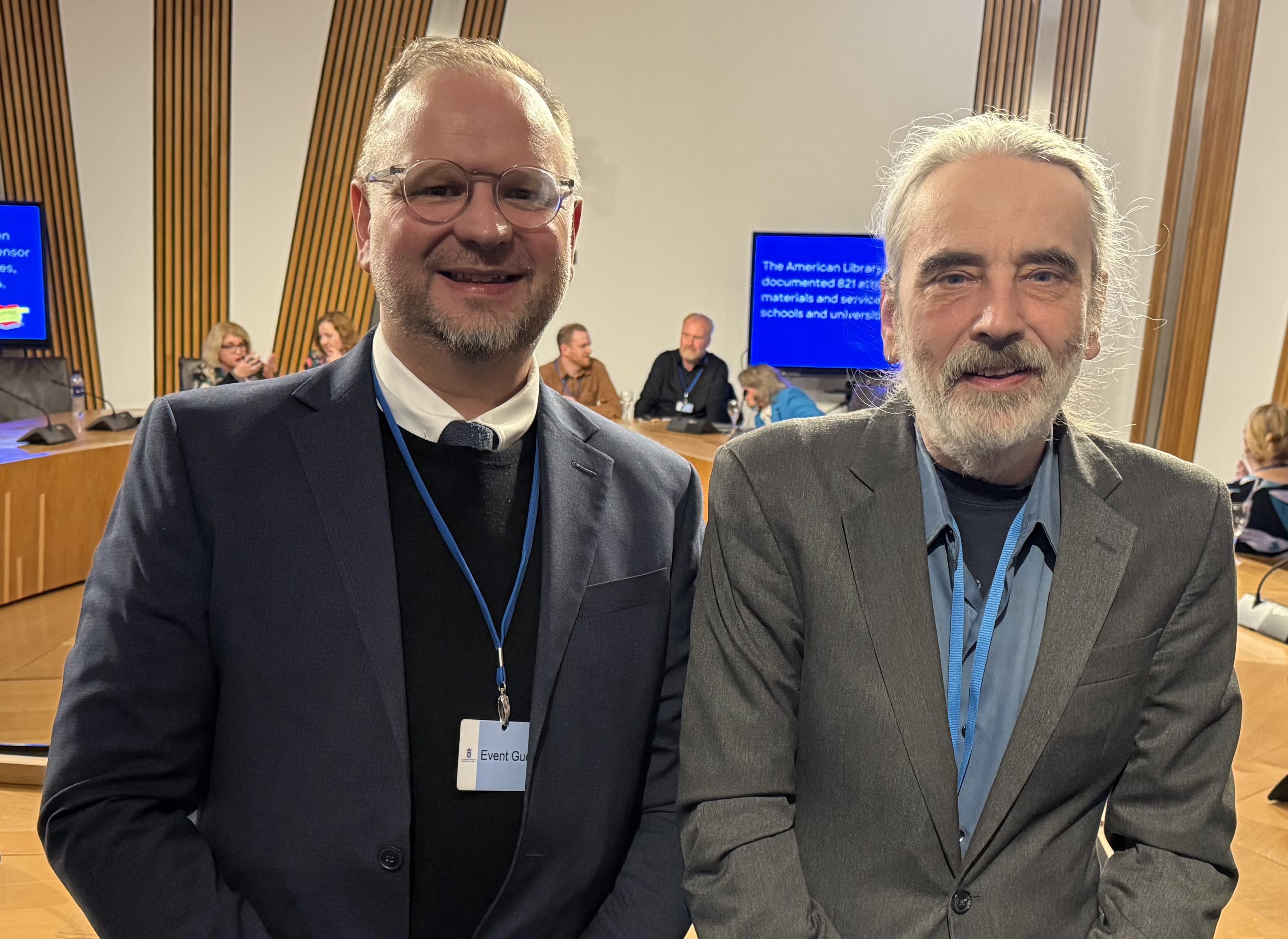
It was great to meet old and new faces in Scotland’s library world, especially to catch up with my Napier PhD colleague Drew Feeney.
[1] Everyone has the right to freedom of opinion and expression; this right includes freedom to hold opinions without interference and to seek, receive and impart information and ideas through any media and regardless of frontiers.
[2] This chimes with recommendations from the recent school librarians and mis/disinformation project.
[3] I believe SB meant ‘argument’ in the sense of ‘discourse’.
 Bruce's IT-ish world