A few hours of horizontality makes a lot of difference! Wegene has had some interesting ideas, so my work for tomorrow is cut out: reading the book and indulging in powerpoint. Continue reading
Scintillating in São Paulo (update)
Reply

A few hours of horizontality makes a lot of difference! Wegene has had some interesting ideas, so my work for tomorrow is cut out: reading the book and indulging in powerpoint. Continue reading
| depart | at (UK time) | arrive | at (UK time) | mode |
| home | 3pm | Edinburgh airport | 15:30 | taxi |
| Edinburgh | 18:00 supposedly | Frankfurt | 19:55 supposedly | flight LH965 |
| Frankfurt | 21:05 | Rio de Janeiro | 08:50 | flight LH500 |
| Rio de Janeiro | 11:20 | São Paulo | 12:30 | flight LH3528 |
| São Paulo | 3pm | Ibis Styles Faria Lima | I forget! | Renato’s car |
So here we are in São Paulo, after little sleep, some wondering about and far too much walking from gate to gate, only just making the second and third flights. I’ve not had anything like enough sleep, which is predictable, but have already seen some fab things. Continue reading
| # | When | What | outcome and notes |
| 1 | July | RIVAL: community event on the theme of LIS research impact: | success! Also enabled further funding application (line 5) |
| 2 | July | applying for GCRF funding for PB in Brazil | success! See line 7 |
| 3 | July | marking work-based learning 2017-18 final reports | ——- |
| 4 | September | Drafting an idea for some public engagement/democracy work | to revisit in 2019 |
| 5 | September | RSE funding application to follow up RIVaL: RIVaL network | success! Work to start in Feb 2019 |
| 6 | October | marking work-based learning 2018-19 initial reports | ——- |
| 7 | October to present | PB in Brazil: whether and how PB benefits the very poor in Sao Paulo Bruce going to Sao Paulo 4 to 27 Jan, Wegene 4 to 13 Jan | LitRev in progress builds on CSI’s relationship with University of Sao Paulo |
| 8 | November | marking BSAD coursework 1 | ——- |
| 9 | November | application for RIO funding to run WriteNow! writing sessions in 2019 | success! working with Frances |
| 10 | December | marking work-based learning 2018-19 mid-year reports | ——- |
| 11 | December | marking BSAD coursework 2 | ——- |
Could I offer a short course or other help to students’ improve their report-writing skills?
| 12 | July | contribution to 2018 Digital Governance in Municipalities Worldwide: A Longitudinal Assessment of Municipal Websites Throughout the World | fancy certificate of thanks |
| 13 | July to present | minuting meetings between Community Councils Together on Trams and Edinburgh Council’s Trams Team | better citizen-involvement? |
| 14 | September | Taking part in a follow-up to research by the Scottish Community Development Centre on community councils. | led to involvement in draft PB charter |
| 15 | September to present | member of £eith Chooses steering group | voting Saturday 23 February 2019 |
| 16 | October, November | further participation in Scottish Government (SG) Online Identity Assurance stakeholder group | TBC |
| 17 | November | participation in debate/research on governance of and possible new powers for community councils | TBC |
| 18 | December | commenting on Scottish Government draft Open Government Action Plan | appreciated by SG |
| 19 | December | participation in Scottish Government/CoSLA event on mainstreaming participatory budgeting. Write-up of event is in a set of posts starting here | TBC |
| 20 | all year | minutes and websites for three Edinburgh community councils: | better recording and publicising of hyperlocal government activities |
The content of these posts has now been moved here: https://bruceryan.info/resources/mainstreaming-participatory-budgeting-event
Individual pages can be accessed via these links:
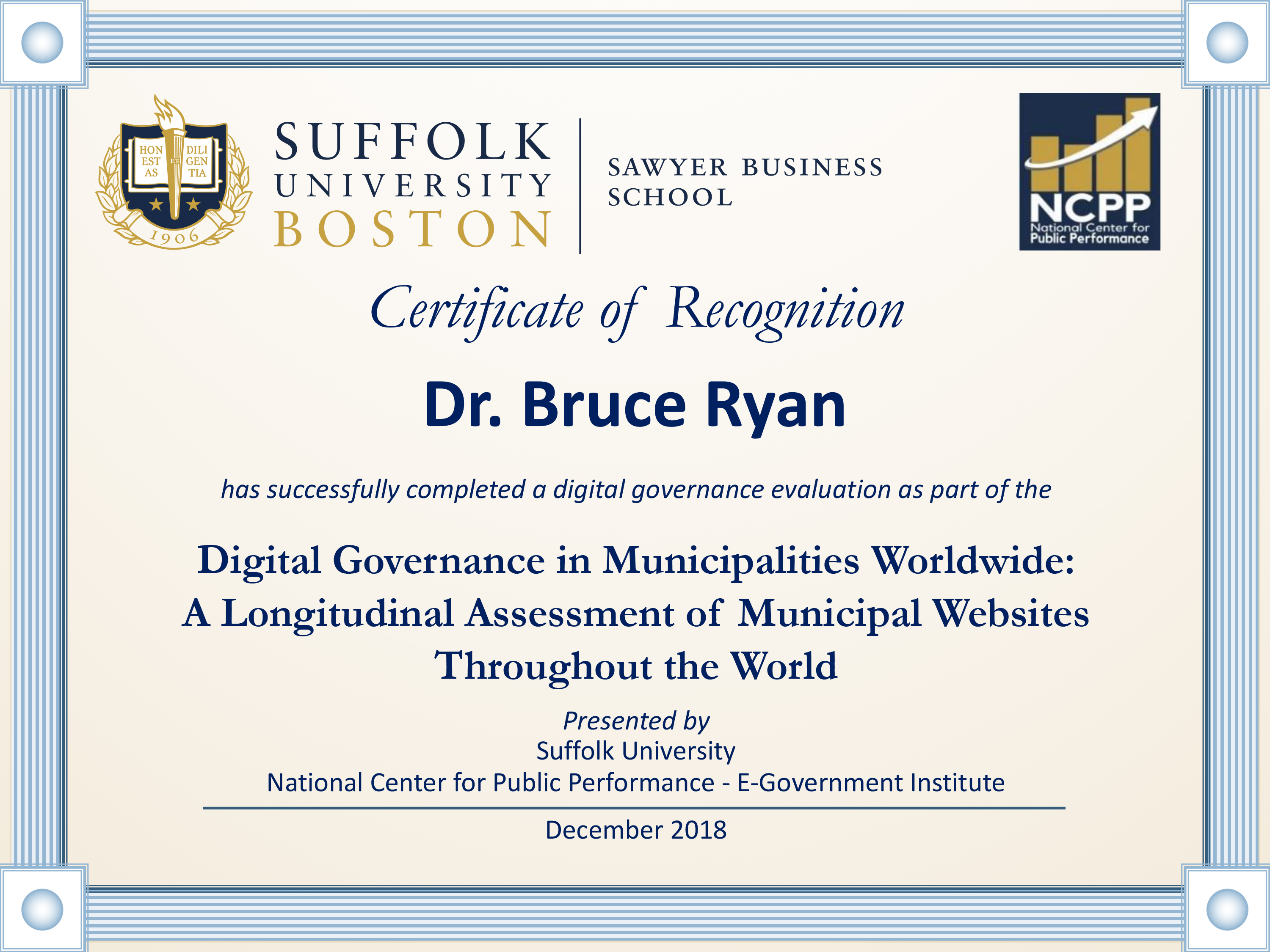
I’ve just received the following email and certificate:
Dear Dr. Bruce:
Thank you for your participation as a surveyor in 2018 Digital Governance in Municipalities Worldwide: A Longitudinal Assessment of Municipal Websites Throughout the World. Please find a certificate in recognition of your involvement attached here.
Your work is an important contribution to the ongoing effort to evaluate digital governance in large municipalities throughout the world. The survey produces comparative analyses of e-governance and contributes to the e-governance literature. The final research will be published on our website in early 2019; you will find your name listed in the acknowledgements.
Thank you
Prof. Marc Holzer
E-Government Institute
National Center for Public Performance
Institute for Public Service – Suffolk University
www.publicperformance.org
To celebrate World Digital Preservation Day (29 November), the Scottish Government digital team published its guidance on web archiving.
I’m saddened that public authorities apparently need to be told to do this. Remember the zeroth law of computing: There are two kinds of data: that which has been backed up and that which has not been lost yet. A variant of this is Schofield’s second law.
And remember, there is a difference between a back-up and an archive.
Following on from my last post about Online Identity Assurance, this post is to draw attention to a couple of posts on the Scottish Government Digital blog:
I’m pleased to see in the first of these posts
The first stream will be about developing two end-to-end journeys, taken by people using services, that can be shown to work as a ‘proof of concept’. One will centre on the process of applying for a Child Disability Living Allowance – a benefit that will become the responsibility of the new Scottish social security system in 2020 – with the other relating to the process of applying for the single occupant Council Tax deduction offered by local authorities.
because that implies to me that SG is taking a sensible ‘suck it and see’ approach, rather than trying for a Big Bang that ends up full of issues.
The second of these posts announces that videos of the presentations at the October Stakeholder Group meeting. Here’s the YouTube link: https://www.youtube.com/watch?v=N37xoD04YTM.
And here’s looking forward to more interesting developments in 2019!
My personal side has blogged about £EITH CHOOSES participatory budgeting.

(I’ve been interested in participatory budgeting since at least 2015, thanks to Ali Stoddart‘s talks at the digiCC events I organised, and subsequent conversations with the Democratic Society. Until recently, I’ve not had much direct involvement but am now on the £EITH CHOOSES steering group.)
After much hard work by the steering group and others, £EITH CHOOSES 2018-19 is open to applications. The closing date for applications is 21 January 2019.
View original post 334 more words
There is currently debate about publishing community council members’ contact details. The following is based on my experience of working with 3 community councils for many years, and examining every CC website I could find in 2012 and 2014. From this, I’d advocate:
So what have I got wrong? Shout at me via the comments!
Being involved, no matter how tangentially, with the Scottish Government’s work on online identity assurance (OIA) is important to me for at least five reasons.
The first OIA stakeholder event I attended (March 2018) is written up here. The second (19 June) is written up here.
For the 3rd event (31 March), I used a different tactic – I live-tweeted as well as I could, then collected tweets and other snippets using Wakelet. (This is a successor to Storify, recommended by the fab Leah Lockhart on advice from Ross McCulloch.)
So, so long as Wakelet permits it, my OIA wakelet is here. Comments are very welcome!